What Spinal Decompression Actually Does to a Disc
Your discs are the shock absorbers between the bones of your spine. When one bulges or herniates, it presses on a nearby nerve. That is the pain, sciatica, or tingling you feel down a leg or arm.
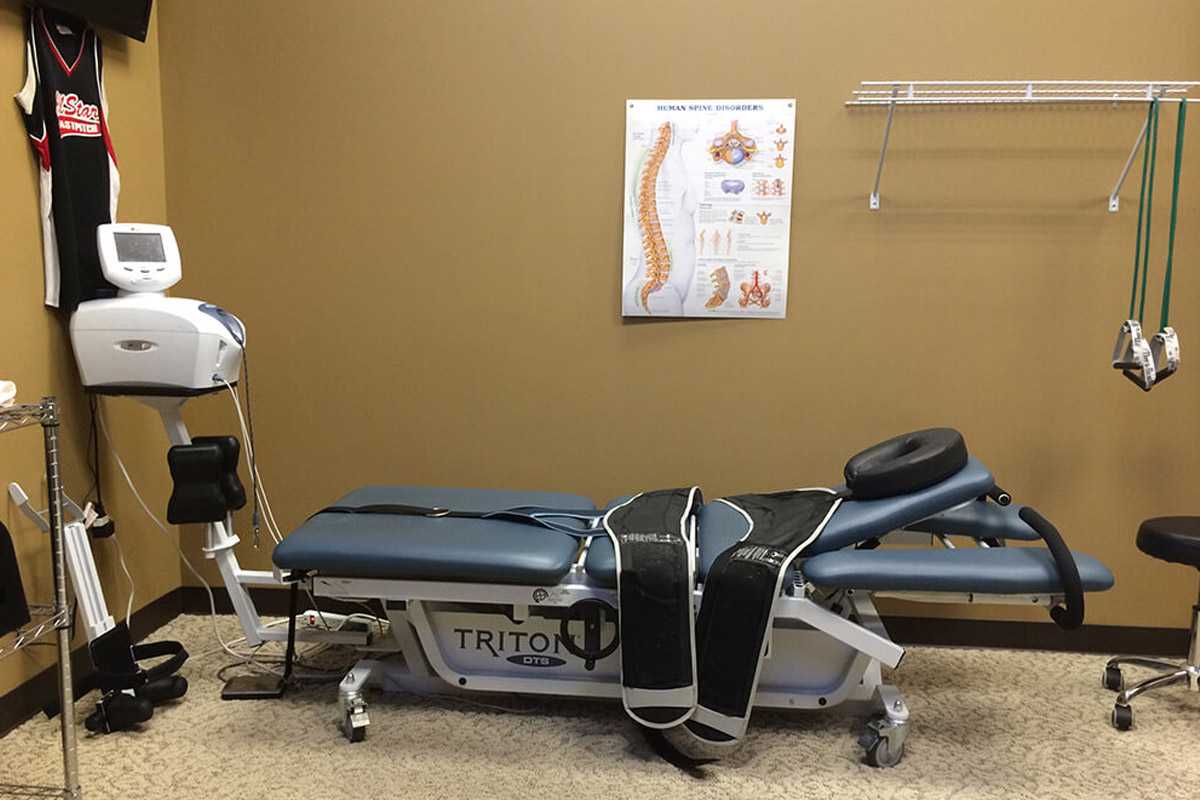
Here is the short version of how the table fixes that:
- It is not flat traction. The pull happens at a targeted angle, in slow cycles of tension and release.
- Your muscles relax. Those slow cycles keep your back from tensing up, so the sore segment can gently open.
- A vacuum forms inside the disc. That negative pressure coaxes the bulging material back toward the center, off the nerve.
- The disc gets fed. Water, oxygen, and nutrients flow back into a disc that was too compressed to heal on its own.
Most people say it feels like a slow, easy stretch. Some relax enough to nearly fall asleep on the table.
Conditions We See It Helps With
Spinal decompression is not a cure-all, and we will tell you if it is not the right tool for your case. When it is a good fit, here are the disc and nerve problems it tends to help.
Herniated and Bulging Discs
This is the most common reason people end up on the table. When disc material pushes out and leans on a nerve, the negative pressure from decompression can coax it back toward the center. It works on both the neck (cervical) and lower back (lumbar).
Sciatica
That sharp, radiating pain down the back of your leg usually traces back to a nerve root getting pinched in your lower spine. Take the pressure off the source, and the leg symptoms often ease with it. Decompression targets the disc doing the pinching rather than just numbing the leg.
Degenerative Disc Disease
Discs lose height and water content as the years add up, which crowds the nerves nearby. Decompression helps pull fluid and nutrients back into a worn disc. It tends to help most before the disc has collapsed completely.
Pinched Nerves and Radiculopathy
When a nerve is compressed, you feel it as numbness, tingling, or weakness rather than a straightforward ache. Opening up the space around that nerve is exactly what the table is built to do. Relief often shows up as the pins-and-needles feeling fades.
Facet Syndrome and Worn Spinal Joints
The small joints that guide your spine’s movement can wear down and get inflamed. Gently unloading the segment gives those joints a little breathing room. This often pairs well with an adjustment.
Foraminal Stenosis
These are the small openings your nerves pass through as they exit the spine, and they can narrow over time. Decompression can briefly widen that space and take pressure off the nerve. It helps this kind of narrowing more than a fully closed central canal.
Lingering Pain After Back Surgery
Some people still hurt after a procedure that was supposed to fix things. In select cases, decompression offers a non-invasive option worth exploring before considering another surgery. We will review your history and imaging carefully before recommending it.
Disc injuries also show up after rear-end collisions and hard falls. If your pain started with a wreck, our personal injury and car accident team can fold decompression into your recovery and handle the documentation that goes with an injury claim.
Why Choose Raintree Medical and Chiropractic Center as Your Spinal Decompression Chiropractor
Plenty of offices in Lee’s Summit own a decompression table. Here is what you get with us that a single-service clinic usually cannot offer.
- A medical look before the table, not after. Decompression is the wrong move for some spines, including certain fractures, tumors, and hardware. With medical providers and digital X-ray on site, we screen for that first. No referral across town required.
- Everything the disc needs, under one roof. We can pair your sessions with chiropractic adjustments, massage therapy, cold laser therapy, and strengthening in our rehab gym. Combining care is what keeps the pain from coming back.
- Room on the schedule. Decompression works best on a steady rhythm. With multiple full-time chiropractors seeing patients six days a week, we can keep you on one.
- Straight talk about cost and coverage. We verify your benefits and explain what your plan covers before you commit. No surprise bills, no year-long contracts.
Patients across Lee’s Summit and the south Kansas City metro have given us a 4.9-star rating across more than 1,000 reviews.
What to Expect from Spinal Decompression Therapy
1. Evaluation and Imaging
Your first visit is about finding the real source of your pain, not booking you for twenty sessions on the spot. We review your history, examine how you move, and use imaging when it is needed to confirm that you are a good candidate.
2. A Treatment Plan Built Around Your Case
If decompression fits, we map out how many sessions to expect and which supporting therapies will speed things along. Most people need somewhere in the range of 15 to 30 sessions over roughly six to eight weeks, though milder cases often turn a corner sooner.
3. The Sessions
You lie down, comfortable, while a harness supports you at the hips or upper body. The table does the work in slow cycles for about 15 to 30 minutes. There is nothing to push or pull on your end.
4. Support Around the Disc
Many visits pair the table with an adjustment, laser, or muscle work, and we often add targeted exercises through our sports rehab and physical therapy so the muscles that stabilize your spine can hold the progress.
5. Progress checks
We reassess as you go and adjust the plan based on how your body responds, then send you home with a short routine to protect your spine long term.
When Decompression is Not the Answer
We would rather lose a table booking than put you on it if it is not safe or smart. Decompression is generally not recommended during pregnancy or for people with severe osteoporosis, spinal fractures, spinal tumors, or certain surgical hardware.
If your evaluation points somewhere else, our team can connect you with the right care through our primary care and medical providers rather than sending you out the door with a shrug.
Spinal Decompression Near You in Lee’s Summit
Our clinic sits off SW LeMans Ln and welcomes patients from Raintree Lake, Lakewood, Greenwood, Raymore, Belton, the Longview area, and south Kansas City. Parking is easy, and appointments are available six days a week.